


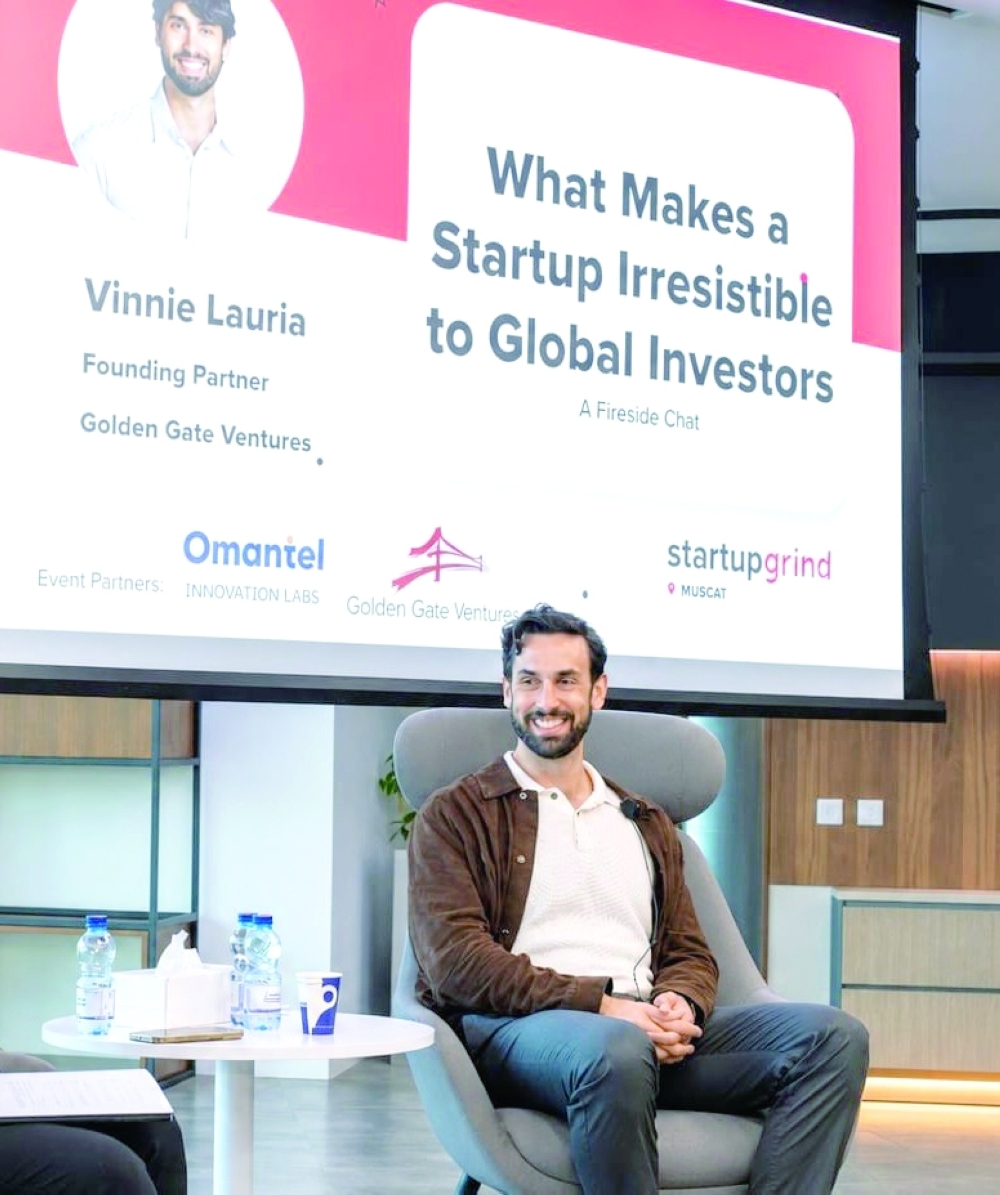





MUSCAT: Founders in Oman must look beyond the domestic market from the outset if they are to build investable companies, according to insights shared by Vinnie Lauria, Founding Partner at Golden Gate Ventures, during a session organised by Startup Grind Muscat, hosted by Walaa Hamdan.
While the discussion reflected an open and practical exchange with the local startup community, it also highlighted a structural challenge for founders in smaller markets such as Oman: the task is not only to build a good company, but to build one capable of scaling beyond its home base.
Lauria outlined three key considerations — early cross-border thinking, signals of investability and a clearer understanding of how investors make decisions.
“Building only for the domestic market may feel disciplined, but it can also be limiting”, he said, noting that startups in smaller economies need to think in more than one country from an early stage.
This is particularly relevant in Oman, where the startup ecosystem continues to gain traction amidst broader economic diversification efforts. Founders are often encouraged to scale, but less frequently guided on what that entails in practice.
Lauria cautioned against the common approach of focusing solely on achieving market leadership locally before expanding. In some cases, he observed, companies that remain concentrated on their first market risk being overtaken by competitors that expand earlier and adapt faster across multiple markets.
On investability, Lauria stressed that ambition alone is insufficient. Investors, he said, look for clear indications that a business can operate across different environments.
He pointed to the composition of founding teams as one such indicator, noting that teams with international exposure or diverse backgrounds are often better equipped to navigate new markets. He cited Carro as an example of a company that benefitted from cross-border insight within its founding team.
“What worked in one country did not automatically work in another. The ability to adapt the model was critical”, he said.
Even where founders are locally rooted, investors still assess their ability to operate across cultures — whether through prior experience, partnerships or exposure to international markets.
Lauria also highlighted a recurring gap in how founders approach fundraising. Venture capital firms, he explained, typically invest based on defined theses aligned with specific sectors and trends.
“A rejection does not necessarily mean the idea is weak. It may simply mean the company sits outside that investor’s focus”, he said.
As such, founders were advised to take a more targeted approach to fundraising — identifying investors whose mandates align with their business and refining their pitch through early-stage engagement before approaching priority investors.
Another key point was the importance of focus. Presenting a broad or multi-directional business model may appear ambitious, but can signal lack of clarity to investors. Early-stage companies, Lauria noted, tend to be more compelling when built around a clearly defined problem and a focused solution.
The discussion also touched on how traction is evaluated. Investors increasingly look beyond headline growth figures, focusing instead on user behaviour, engagement and retention. Metrics that are inflated or driven largely by paid channels may undermine credibility if they do not reflect genuine demand.
For Oman, the broader takeaway is a shift towards more deliberate startup design as the ecosystem matures. The emphasis is expected to move from activity alone to building companies with the capacity to scale regionally.
“In a small market, building a good company is only the start. The larger challenge is building one that can travel”, Lauria said.
The message aligns with Oman’s wider economic ambitions, underscoring the need for startups that are not only locally relevant but also capable of competing beyond national borders.
WALAA HAMDAN & JOMAR MENDOZA
Oman Observer is now on the WhatsApp channel. Click here


